Indoor Climate
The fundamental goal of buildings is to ensure that being indoors is better than being outdoors. We must assume this goal to have been archived, as we now spend approximately 90 % of our lives indoors. Increasing requirements for airtight buildings and a strong focus on energy efficiency in existing buildings have created a growing need to actively address indoor environmental quality (IEQ).
Indoor climate is a broad and complex field based on four core pillars:
- Acoustic indoor climate (sound conditions)
- Visual indoor climate (lighting and visual conditions)
- Thermal indoor climate (temperature conditions)
- Atmospheric indoor climate (air quality)
How can Transition help you?
At Transition, we provide comprehensive guidance within the field of indoor climate. We support companies and public institutions throughout all phases of indoor climate activities. Our solutions are tailored to specific needs and avoid silo thinking.
We are up to date with the latest research and knowledge in the field, and we actively participate in various developments projects that help shape the national agenda on indoor climate.
We have developed a method for working strategically with indoor climate. Our approach is based on three components: the measured, the probable, and the experienced indoor climate. Together, these make it possible to combine technical measurements and screenings with human experiences. Measurements document current conditions, while screenings identify likely conditions under design criteria. Human experiences are gathered by adapting existing workplace assessments (WPAs), where targeted questions about indoor climate contribute to high quality, standardised, and actionable insights.
Experience shows that indoor climate issues are often perceived differently than they are measured, which is why the indoor climate triangle provides a solid foundation for targeted efforts towards a healthy and productive working environment.
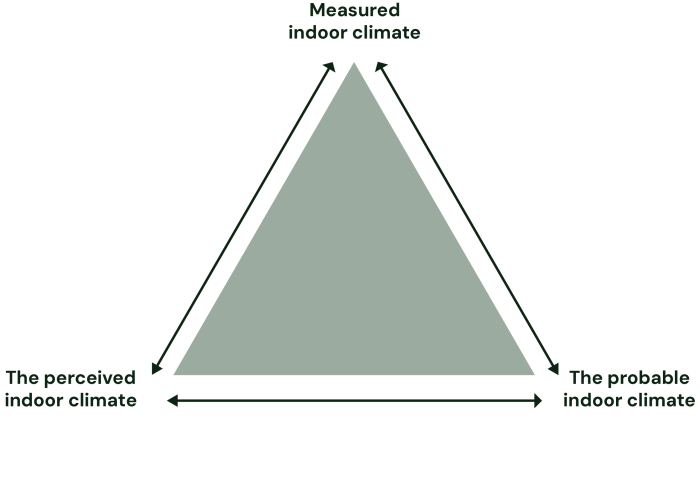
To effectively address indoor climate issues, it is essential to understand the extent of the problem. We offer services to map exactly this.
When documenting indoor climate quality, measurements are carried out according to the latest SBi guidelines, and we analyse data following the newest recommendations and legislation in the field.
We offer measurements of the following indoor climate parameters:
Thermal indoor climate
- Air temperature (dry bulb)
- Thermography – tracking drafts
Atmospheric indoor climate
- Relative Humidity
- CO2 concentration in the air
- Radon
- Volatile organic compounds (VOC) (Gas chromatographic analyses – GC/MS)
- Airflow speeds in ventilation ducts
- Tracking air movements using smoke
Visual indoor climate
- Lighting levels (lux levels)
Acoustic indoor climate
- Simple reverberation time measurements (Room acoustics)
In collaboration with several municipalities, we have devolved a methodology that uses a simple questionnaire about the psychical conditions in a room to map the likely indoor environmental quality. This means that no measurements are taken; Instead, a straightforward assessment is made of whether the correct measures have been taken to ensure good indoor climate.
The result reach approximately 90 % accuracy, matching the conclusions that independent indoor climate researchers would draw from measurements.
This method is used as a strategic tool to quickly overview a large building portfolio and to estimate the cost of addressing identified issues.
The method maps the likely indoor environmental quality at room level and across the four main pillars of indoor climate: Thermal, atmospheric, visual and acoustic. Based on this, a combined assessment of each room is created on an easy-to-understand red/yellow/green scale, which can be used for, for example, political reporting on status and progress.
The method can be used by municipalities to generate and report on KL’s key figures for IEQ.
We offer screening both with our own tool and with IK-check, which we helped develop. Our tool can be used for schools, daycares, care centers etc., and IK-check can be used at schools.
In connection with DGNB certification of new buildings, radon and VOC emissions are knockout criteria. They must be documented and cannot be present in concentrations exceeding certain thresholds.
We offer measurements of TVOC and radon according to the DGNB standard. We perform spot measurements of VOC using DNPH and ATD tubes combined with high precision Gilair Plus pumps. The tubes are sent for analysis at third-party laboratories. The analysis results are used to calculate risk factors for individual VOCs and TVOC, thereby calculating the points awarded according to the DGNB standard.
Radon is measured using dosimeters, which are analysed by an external laboratory.
It is also possible to gain additional points for your DGNB documentation by performing daylight simulations that document a satisfactory daylight level during the building’s hours of use. We also perform these simulations using Rhino/Grasshopper software.
Strategic consulting
We assist property managers of large building portfolios in establishing strategies for how indoor climate quality should be improved over time across their building stock.
We call these Strategic indoor climate plans. Each plan is unique to the individual building owner but typically includes the following:
- Mapping the current IEQ status across buildings (Baseline)
- Establishing an indoor climate policy: What indoor climate does the property manager want to offer their building users
- Setting goals and objectives aimed at improving the baseline to meet the indoor climate policy’s defined level of quality
- Developing an action plan for the coming years and a prioritized renovation schedule for the buildings
- Establishing new work processes related to indoor climate within the organisation to ensure ongoing progress and documentation of efforts
- Management reporting on ongoing progress compared to baseline and goals
When a building has not yet been constructed or renovated, the IEQ is simulated or calculated based on planned changes.
We largely follow the methods defined in the industry guidelines for indoor climate calculations.
We offer calculations and simulation documentation of most indoor climate parameters. The results can be used, among other things, to document compliance with building regulations regarding IEQ.
We are happy to help you successfully complete your indoor climate efforts. Once you understand the problems and have made a plan to improve IEQ, we assist with solution design, documentation of expected effects, tender support, supplier management, and quality assurance.
There are two aspects of indoor climate quality. One is the undetectable indoor climate that users do not notice in their daily life. This is mapped through screenings and measurements. The other is the detectable indoor climate, which is the part of the indoor climate that users can sense and evaluate upon. It should be comfortable to stay in buildings. Therefore, it is very important that we also evaluate indoor climate quality based on the users’ experiences.
We offer several approaches to this evaluation:
- Improvement of the indoor climate-related questions in workplace assessments. Workplace assessments (APVs) are obvious sources of knowledge about perceived indoor climate, as they are mandatory at certain intervals.
- Post occupancy evaluation (POE). We offer to carry out POE after a building have been put into use.
- Custom-designed user satisfaction surveys
Together with Aalborg University, DTU, Ringkøbing-Skjern Municipality, Frederikshavn Municipality, Favrskov Municipality, and with support from Realdania, we have developed a new method to improve the indoor climate questions in municipal workplace assessments (APVs). The method can also be used for ordinary surveys of perceived indoor climate.
Selected cases
Do you have questions regarding indoor climate?
Contact
Nicolaj Krogsbæk Bøgh
Head of Energy & Indoor Climate
- nicolaj@transition.nu
- +45 2621 5676